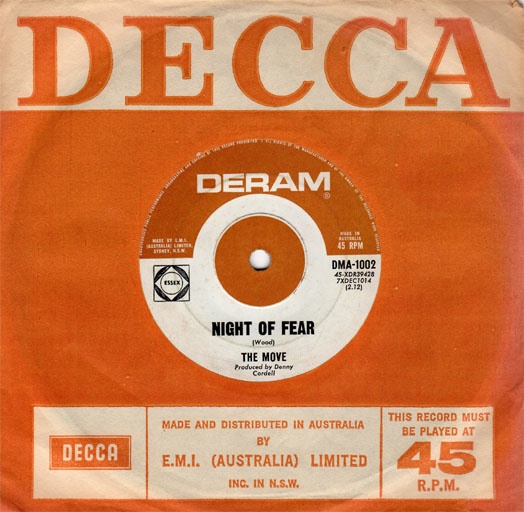
Category: British-owned record label
Date: 1929-present
Location: based in UK; no Australian division
Subsidiary labels: London, Deram
Austraklian distributor: EMI (Australia) Limited
| MILESAGO: Australasian Music & Popular Culture 1964-1975 | Record Labels |
DECCA RECORDS
| |
Category: British-owned record label Date: 1929-present Location: based in UK; no Australian division Subsidiary labels: London, Deram Austraklian distributor: EMI (Australia) Limited |
History
The UK-based Decca Records was one of the most important and influential recording companies of the 20th century. Like many record labels, the history of the company is rather confusing -- for many years after World War II there were two separate companies operating internationally under the same name: Decca UK, the original parent company, and Decca USA, originally a subsidiary of the British firm, which split from it during World War II. As well as its renowned classical and jazz catalogues, Decca is famous in rock music history for its association with The Rolling Stones, who recorded all of their 1960s albums and singles for the label.
Decca was a leader in the British recording industry for over half a century. The company made many major technical breakthroughs, beginning with its famous "FFRR" (Full Frequency Range Recording) system developed during WWII, which for the first time made it possible to record sounds across the full range of human hearing in a bandwidth from 80-15000 Hz, with a signal-to-noise ratio of 60dB. In 1954 Decca engineers Arthur Haddy, Roy Wallace and Kenneth Wilkinson developed the famous Decca tree, a stereo microphone recording system devised for recording large orchestras. Decca's first recordings in stereo were madeat the Victoria Hall in Geneva on 14-28 May 1954, only three months after RCA Victor in the US , making Decca the first European record company to do so. Decca UK also gained a crucial lead over its rival EMI by rapidly adopting the new LP format (invented by Columbia Records USA), which EMI initially resisted, and the adoption of the LP format, combined with the company's new FFSS (Full Frequency Stereophonic Sound) system established Decca as a leader in high fidelity recording. In the 1970s Decca created its own digital recording system and in the early 2000s the company was actively involved in the development of the SACD and DVD-A recording formats.
Decca was founded in the UK by Edward Lewis in 1929. The 'Decca' trade name was first used in 1914 for the "Decca Dulcetphone" a portable gramophone manufactured by Barnett Samuel & Sons Ltd, a company Lewis acquired in 1934. Decca gradually expanded into other countries, mainly through licencing deals with other labels. H.W. van Zoelen became the Decca distributor in The Netherlands in 1929 and formed Hollandsche Decca Distributie (HDD) in 1931 as the exclusive Decca distributor for the Netherlands and its colonies.
Decca bought out the bankrupt UK branch of Brunswick Records in 1932, bringing in stars like Bing Crosby and Al Jolson to its roster. Decca also bought out the Melotone and Edison Bell record companies. In 1934 Lewis financed the establishment of Decca's American subsidary, founded by Jack Kapp, and in 1935 Deutsche Gramophon became Decca's German licensee. By 1939, Decca and EMI were the only major record companies still trading in the UK.
Decca's American branch was sold off during WWII and operated as an independent company thereafter. Decca UK eventually grew dissatisfied with US Decca's promotion of the British Decca recordings, and terminated their mutual licencing deal, but American Decca owned the rights to the Decca name in the US and Canada, so from 1947 onwards Decca UK marketed its records in the Americas through the London Records label. The London name was also used by UK Decca in the British market to release titles licensed from American labels such as Imperial, Chess, Dot, Atlantic, Specialty and Sun, as well as the first few UK releases from Motown. In the 1960s UK Decca signed more licensing deals with Big Top, Monument, Parrot, Philles (Phil Spector) and Hi.
In Britain and Commonwealth countries, London became a major licensing outlet for recordings sourced from American labels such as Cadence, ABC-Paramount, Atlantic, Imperial and Liberty. Conversely, British Decca retained a non-reciprocal right to license and issue American Decca recordings in the UK on their Brunswick Records (US Decca recordings) and Coral Records (US Brunswick and Coral recordings) labels. This arrangement continued until 1967, when a UK branch of MCA was established utilizing the MCA Records imprint, with distribution fluctuating between British Decca and other English companies over time.
In 1952 Decca (USA) acquired a controlling interest in Universal Pictures. A decade later in 1962 MCA Inc. and Universal Pictures officially merged when MCA acquired American Decca, Universal's parent company. The Decca name was phased out by MCA in America in 1973 in favour of the MCA Records label; the final American Decca release, "Drift Away" by Dobie Gray, became a major hit, reaching #5 on the Billboard chart and earning a gold record.
In 1979 Decca UK and London Records were acquired by Polygram (which was then jointly owned by Philips and the German Siemens group) and British Decca's pop catalogue was taken over by Polydor Records. A proposed 1983 merger between Polygram and Warner Music was forbidden by both the US Federal Trade Commission and Germany's cartel office. Philips then acquired 40% of Polygram from Siemens, buying the remaining shares in 1987. Two years later, Philips sold 16% of Polygram in a deal that valued the record group at US$5 billion. In the mid-1990s, MCA Nashville Records revived Decca in the US as a country music label.
In 1998, as part of large-scale restructuring at Philips (amid speculation that the group would collapse) Polygram was sold to Seagram for US$10 billion. Seagram then combined Polygram with Motown and its other recording interests to create the Universal Music Group. Two years later Seagram was acquired by Vivendi for US$34 billion, becoming Vivendi Universal.
The Decca label is
currently in owned by the Universal Music Group worldwide. In 1998 PolyGram, British Decca's parent
company, was acquired by Universal Studios (which officially dropped the MCA name after
the Seagram buyout), finally consolidating the Decca trademark under the ownership of one company. In the
US, the Decca country music label was shut down and the old London
classical label was renamed Decca. In 1999, Decca was merged with
Philips Records to create
the Decca Music Group (known as Universal
Music Classics Group in the USA).
Jazz and popular music
Thanks to its American subsidiary and its acquisition of the Brunswick label, Decca enjoyed enormous success in the jazz
and popular music fields
in the 1930s and 1940s. Its stellar roster included Louis Armstrong,
Count Basie, Louis Jordan (one of the biggest-selling artists of that
period), Jimmie Lunceford, Bing Crosby, Jane Froman, The Boswell
Sisters, Billie Holiday, The Andrews Sisters, Ted Lewis, Judy Garland,
The Mills Brothers, Billy Cotton, Guy Lombardo, Chick Webb,
Bob
Crosby, The Dorsey Brothers (and subsequenrtly Jimmy Dorsey after the
brothers split), Connee Boswell and Jack Hylton, Victor Young, Earl
Hines and Claude Hopkins and Al Jolson. In 1942, Decca released the
first recording of "White Christmas" by Bing Crosby. Crosby's second
version of the song, recorded in 1947 for Decca, became the
best-selling single ever released, a record it
held until
1997.
In 1943, Decca USA made history by releasing the first 'original cast'
recording of a Broadway musical, with a set of 78rpm records -- an
"album" -- comprising
nearly all the songs from Rodgers and Hammerstein's hit musical Oklahoma!. These were
performed by the original Broadway cast,
using the show's orchestra, conductor, chorus, and musical and vocal
arrangements. The enormous success of this album was followed by
original cast recordings of Carousel
and Irving Berlin's Annie
Get Your Gun,
both featuring members of the original casts
of the shows and utilizing those shows' vocal and choral arrangements,
and Decca's lead was soon followed by other major labels including
Columbia and RCA. In the 1950s Decca again broke new ground by
releasing soundtack albums from major Hollywood films, and they were
one of the first labels to release these records in stereo.
Country (Decca USA)
From the late 1940s Decca USA developed a significant roster of
country artists, including Kitty Wells, Johnny Wright, Ernest Tubb,
Webb Pierce, The Wilburn Brothers, Bobbejaan Schoepen and Red Foley.
Decca quickly became the main rival of RCA Records in American country
music and remained so for several decades. In
the
late 1950s, Patsy Cline's recordings were released on the US Decca
label under licence from 4 Star
Records, who owned her contract. Although she reportedly saw little
money from this deal. In 1960, she signed with
Decca directly and released two more albums and numerous singles while
she was alive, plus several more albums and singles issued after her
untimely death in a plane crash in 1963. The Wilburn Brothers
were ultimately signed to a lifetime contract with Decca. Doyle
Wilburn was instrumental in securing a recording
contract for Loretta Lynn,
who signed to Decca US in the early 1960s and remained with the label
for several decades. Much of the credit for label's success is due
to renowned A&R manager and producer Owen Bradley; late in
his career Bradley produced Canadian singer kd lang, who had been
greatly influenced by the recordings Cline made with Bradley.
Classical (Decca UK)
After WWII, Decca UK developed a highly regarded classical catalogue that
included renowned European orchestras and conductors such as Ernst
Ansermet and Sir Adrian Boult, solosts such as Kathleen Ferrier, Julius
Katchen and Radu Lupu, and even film score suites by written
and
conducted by famed Hollywood
composer Bernard Herrmann. In 1954 Decca recording engineers Arthur
Haddy and Kenneth Wilkinson
developed the famous Decca tree, a stereo microphone recording
system for big orchestras. Decca was the first Euopean label to record
classical music in stereo, beginning in May 1954, only three months
after RCA's first stereo recordings in the USA. Much of Decca's success
in the classical field can be attributed to its technical innovations
-- including the FFRR process and its later "Phase 4" stereo system --
and the influence of its senior producer, John Culshaw, who
revolutionised the recording of opera. Among the label's most famous
and critically
acclaimed recordings was its groundbreaking stereo recordings
of Wagner's Ring Cycle, begun in 1958, conducted by Sir Georg
Solti and produced
by Culshaw. This landmark series was voted the best recording of
all time by readers of British music magazine The Gramophone.
Rock'n'roll, pop
and rock
In 1954, American Decca released "Rock Around the Clock" by Bill Haley
& His Comets. Haley's producer, Milt Gabler, had
previously worked with million-selling jazz artist Loius Jordan, whose
Decca sides had laid the groundwork for early
rock'n'roll and most of the classic Bill Haley recordings were made at the same studio, Decca's Pythian
temple studio in New York. "Rock Around the Clock" was initially
only
moderately successful, but when it was used as the theme song for the
1955 film Blackboard Jungle, it became the first
international rock and roll hit, and the first such recording to go to
#1 on the American charts. According to the Guinness
Book of Records, it went on to sell 25 million copies,
returning to the US and UK charts several times between 1955 and 1974.
Ironically, Decca's Australian distributor EMI passed on the record and
it was snapped up by the fledgling Festival label, enabling Festival to
score its first major hit. RCA severed its longstanding distribution deal with EMI in
1957, allowing British Decca to market and distribute Elvis
Presley's recordings in the UK.
Decca UK enjoyed considerable success with its pop-rock roster in the
1960s, although the company's reputation suffered from a string of
notorious missed opportunities. In 1960, they refused to release "Tell
Laura I
Love Her" by Ray Peterson and even destroyed thousands of copies of the
single, allowing a rival version by Ricky Valance on
EMI's Columbia label to go to #1 on the British charts.
In 1962 Dick Rowe, then the A&R manager of EMI's pop division,
famously declined to
sign The Beatles in favour of Brian Poole & The
Tremeloes, famously telling manager Brian Epstein that "We don’t
like their sound,
and guitar music is on the way out". Other
notable refusals in this period included The Yardbirds and Manfred
Mann. both of whom went on to great international success.
Staff producer Hugh Mendl (1919-2008) played a significant role in
Decca's success in the popular field from the 1950s to the late 1970s.
His first major production credit was pianist Winifred Atwell, whom he
discovered in the mid-1950s, he produced "Rock Island Line", the
breakthrough skiffle hit for Lonnie Donegan, and he is credited as the
first executive to spot the potential of singer-actor Tommy Steele.
Mendl's other productions included the first album by humorist Ivor
Cutler, Who Tore Your Trousers? (1961), Frankie Howerd at The Establishment
(1963), a series of recordings with Paddy Roberts (best-known for "The
Ballad of Bethnal Green"), numerous "original cast" and soundtrack
albums including Oh! What a Lovely War and even an LP record of the 1966 Le Mans 24-hour race, inspired by his life-long passion for motor-racing.
Mendl was a driving force in the establishment of Decca's progressive
subsidiary Deram, most notably as the executive producer of The Moody
Blues' groundbreaking 1967 LP Days of Future Passed.
He is credited with championing the group, battling against Decca's
notorious parsimonious treatment of their artists, ensuring that the
Moody Blues had the time and resources to develop beyond their beat
group origins into progressive rock, and he also used profits for pop
sales to cross-subsidise recordings by avant garde jazz artists like
John Surman.
Mendl was sidelined by a heart attack in 1979; during his convalescence
Sir Edward Lewis died and Decca was taken over by PolyGram, and when he
returned to work he discovered that his office had been cleaned out and
his diaries -- which would have provided a vital insight into the
company's history -- had been thrown away.
Rowe did not repeat his mistake with his next major signing. He snapped up The Rolling Stones in 1964 and by 1966 they ranked second only to The Beatles in terms of popularity and sales, scoring a string of trans-Altantic hits. They were by far Decca's most successful pop act, and remained with the label until 1970, when they established their own Rolling Stones Records imprint. The Stones later voiced strong criticism of Decca's handling of their career -- non-payment of royalties were a key issue, and they also fought (and lost) a famous battle over the infamous "toilet wall" cover for their 1968 album Beggar's Banquet, which was rejected by Decca's management, forcing the group to settle on the so-called "Invitation" design. Other successful Decca pop/rock acts included Irish band Them, led by Van Morrison, and John Mayall's Bluesbreakers, whose legendary pair of mid-'60s albums successively made Eric Clapton and Peter Green into heroes of the electric blues guitar.
In 1966 Decca UK lost a key source of American records when Atlantic Records switched distribution to Polydor Records in order to gain access to British acts which were unavailable to them under Decca distribution. Decca enjoyed sporadic success with its progressive subsidiary Deram (see below) but the company was further hampered by internal problems, notably Edward Lewis' habit of playing off staff against each other, and its parsimonious attitude to its artists.
Decca UK's fortunes waned in the
1970s -- they lost The Rolling Stones, who set up their own label
(distributed by EMI) and RCA terminated its
distribution deal and established its own UK branch. Althugh it gained
critical acclaim with is progressive releases on Deram (including
Caravan and Curved Air) its only major
commercial successes in this period were Dana's "All Kinds Of
Everything" (on the
Rex subsidiary) and the novelty recordings by The Smurfs. Decca
also missed the boat during the punk/New Wave era, its only major
signings in this genre being Adam & The Ants and
Slaughter & The Dogs. Polygram acquired Decca UK within days
of the death of company founder Sir Edward Lewis in 1980. Over the
intervening years, through a series of mergers and
acquisitions, Decca became part of the Universal Music group.
owned by the French-based Vivendi corporation.
Deram
In the mid-1960s Decca UK established a new imprint, Deram, thanks in
large measure to the efforts of staff producer Hugh Mendl, who
championed The Moody Blues and also channelled prfoits from Decca's pop
division to cross-subsidise avant garde jazz artists like Jon Surman.
Deram was the
first in a wave of "progressive" labels that
grew to include Harvest, Vertigo and Virgin.
The new label's inaugural single was Cat Stevens' "I Love My Dog" (1967); it was followed by his first major hit "Matthew And Son" which reached #2 in the UK later that year. Stevens recorded two LPs for Deram and scored another UK hit with "I'm Gonna Get Me A Gun" in early 1968, but his career was temporarily derailed when he contracted tuberculosis; after his recuperation he moved to Chris Blackwell's Island Records, winning international success in the 1970s.
Deram's
biggest
international act in the late Sixties and early Seventies was The
Moody Blues. They released their
beat-oriented debut album on Decca in 1965 before shifting to Deram and
undergoing a radical change of style. With support from Hugh
Mendl, who secured them the time and resources to develop their music,
The Moody Blues evolved into Britain's first fully-fledged
progressive rock band, and they recorded three hugely
successful psychedelic-progressive concept albums.Using Decca's state-of-the-art recording techniques, they pioneered the
rock-classical crossover, using the famed
London Symphony Orchestra to back their entire debut LP Days of
Future Passed which included their enduring
hit "Nights in White Satin". They followed with two more very successful LPs, In Search of the Lost Chord and On
The Threshold Of A Dream. Subsequent albums were
released on the band's own Threshold label, which was distributed by Decca.
Another big success was blues band Ten Years After, led by guitar ace Alvin Lee, who recorded six LPs for Deram between 1967 and 1972. The young David Bowie scored his few first minor UK hits for Deram, including "Love You Til Tuesday" and "The Laughing Gnome" and these and his other Deram recordings were endlessly repackaged following of his move to RCA and his international breakthrough in the 1970s. Other notable acts who were released on or through Deram include The Move, leading progressive rock groups Caravan, Curved Air and Giles Giles & Fripp, pop vocal act The Brotherhood of Man and UK electric blues band Chicken Shack (which featured a young Christine Perfect-McVie, of Fleetwood Mac fame).
Decca Guitars
A little-known sideline of Decca's pop activities was the
Decca
electric guitar range. These were made for the company in the mid-1960s
by Teisco,
the Japanese guitar company whose products were also variously badged
as 'Kingston', 'Kay' and Audition'. The Junk
Guitars website features an excellent photo a trio of Teisco
'Decca' guitars made in 1966.
Decca in Australia
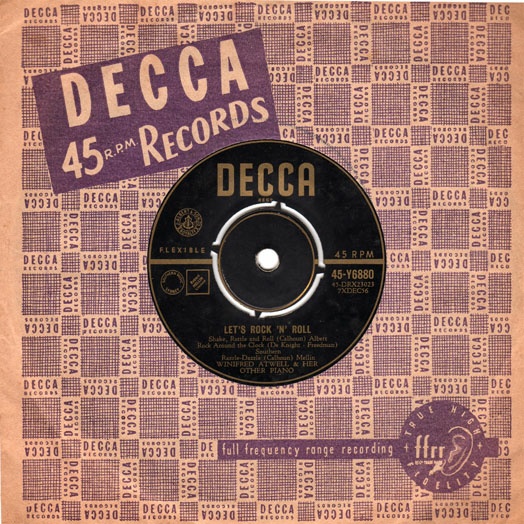 Despite its international successes and unlike most of its competitors, neither
Decca
UK nor Decca USA ever established an Australian subsidiary. Instead
the Decca group relied on a long-standing deal with its
British rival EMI to manufacture
and distribute
its recordings in Australasia. As a result, it was one of the few major labels that never established a
roster of local artists in Australia or New Zealand. One
notable
and unusual exception was singer and actress Lorrae Desmond, who was
signed to Decca while working in the UK in the 1950s and made several
recordings for the label.
Despite its international successes and unlike most of its competitors, neither
Decca
UK nor Decca USA ever established an Australian subsidiary. Instead
the Decca group relied on a long-standing deal with its
British rival EMI to manufacture
and distribute
its recordings in Australasia. As a result, it was one of the few major labels that never established a
roster of local artists in Australia or New Zealand. One
notable
and unusual exception was singer and actress Lorrae Desmond, who was
signed to Decca while working in the UK in the 1950s and made several
recordings for the label.
Decca's single releases in Australia in the 1950s (the '6000' series) were mainly titles by popular mainstream artists such as Winifred Atwell, Kenneth Mackellar, Max Bygraves, Vera Lynn and Tommy Steele, or big band / orchestral acts such as Edmundo Ros, Ted Heath and Mantovani. Decca also released several recordings by The Goons, including the immortal "I'm Walking Backwards for Christmas".
Decca's '7000' series, which began in the late 1950s, still featured many 'MOR' titles (e.g. Anthony Newley, Val Doonican, Eden Kane and later Englebert Humperdinck) but gradually expanded to include pop and and rock acts signed in the Sixties. Significant Australian releases in this genre include Billy Fury, ex-Shadows Jet Harris and Tony Meehan, Brian Poole & The Tremoloes, Heinz, The Mojos, Lulu & The Luvvers, P.J. Proby, Screaming Lord Sutch, The Nashville Teens, Marianne Faithfull, The Zombies, Them, Tom Jones, Unit 4 + 2, the early singles and the first LP by The Small Faces, The Alan Price Set, Hedgehoppers Anonymous, the debut album by Genesis (much repackaged in the wake fo their subsequent success on the Charisma label) and of course The Moody Blues and The Rolling Stones.
Among the more unusual Australian releases on Decca was a 1964 single featuring the original Dr Who theme by the BBC Radiophonic Workshop, and a 1965 single by Greek group Forminx, which included future electronic music star Vangelis.
Decca's London label was also marketed in Australia, and was also manufactured and distributed by EMI. It was launched in 1954 and wasused almost exclusively to release recordings licenced from the USA. This included recordings licenced from American Decca in the 1950s (e.g. Bill Haley) but was mostly used for Decca-UK's American affiliate labels, including:
Discography
For a comprehensive listing of Decca's Australian 45s of the 1950s and 1960s, we recommend the wonderful Globaldog Productions website:Decca '6000'
series Australian singles discography
http://www.globaldogproductions.info/d/decca-6000-series-oz.html
Decca '7000'
series Australian
singles discography
http://www.globaldogproductions.info/d/decca-7000-series-oz.html
Deram Australian singles discography
http://www.globaldogproductions.info/d/deram-oz.html
References / Links
Universal Music Group - History
http://new.umusic.com/history.aspx
Wikipedia
- Decca Records
http://en.wikipedia.org/wiki/Decca_Records
ketupa.net
Polygram/Decca company profiles and history
http://www.ketupa.net/polygram.htm